Friday, October 26, 2007

Excursion to Kyoto


On our final full day of the official culinary tour, the entire delegation boarded our charted buses and headed to Kyoto for some more food and shopping. It was about a 45 minute ride.

Our first stop was the Toji Temple Market. The temple seems like an odd location for Kyoto's largest outdoor market, doesn't it? If I recall correctly, Teresa said there were over 1500 vendors. Here, we found a colorful array of food stalls, Japanese tableware, kimonos, plants, antiques, and everything in between. Ann and I found a pair of his and her used kimonos that we purchased for my youngest sister, Hang. She and her boyfriend Chris will be wearing them to a costume party for Halloween. Look at Pam trying on a purple kimono. Isn't she beautiful?

After spending 2 hours at the Toji Temple market, the delegation had bento boxes for lunch at another temple that was about 10 minutes away.

Our final stop in Kyoto was the Nishiki Street Market, which is where exquisite culinary ingredients and tools can be purchased. Do you believe that each of these mushroom baskets cost about $200-$300 (US)? Outrageous!

Although the trip to Kyoto was only about 45 minutes, the trip home took over 2 hours due to the rush hour traffic. We got back to the Sheraton Miyako Hotel at about 6 pm, which gave us roughly half an hour to get ready for the final farewell dinner reception.

Day 5 - Sayonara Mark, Lecture, Shopping, and Potluck


On day 5, we bid farewell to Mark Chandler (Director of International Trade, City and County of San Francisco). He had been gone long enough, and Mayor Gavin Newsom wanted him back. Mark did a terrific job representing the city of San Francisco and was lots of fun to hang out with. You're a neat guy, Mark. I hope our paths will cross again!

Our first official event of the day (besides breakfast) was a culinary lecture presented by food anthropologist Elizabeth Ando. Elizabeth is a published author and travels the world to give lectures and professional consultations. She came from the US decades ago on a scholarship, fell in love with the country (and one of its men) and decided to stay. She gave a fascinating talk on Japan's culinary history and practices. During the post Q&A session, I shamefully had to admit that the last 'prepared' meal I made was a can of Campbells soup. How embarrassing!

After the lecture, the foodies enjoyed a group teppanyaki lunch at restaurant Tsuki no An. Doesn't that look good?


Then, we had our first free day in Osaka! Ann and I immediately seized the opportunity to go shopping. Shopping in Osaka is heaven! It's just as fashionable, if not more fashionable, than New York City. The main difference is that everything is tailored to fit our petite Asian figures. We wanted to buy everything; however, shopping in Japan is not cheap! Chase Manhattan will understand why I HAD to miss one mortgage payment, right? (By the end of our Japan trip, Ann and I purchased a total of 6 coats, 1 bag, 1 pair of shoes, 2 sweaters, a couple of dresses, a few umbrellas, .... ummm, you get the point. What was United's weight limit again?) While Ann and I did our girly shopping thing, the boys did theirs. However, they were much better behaved. Mom and dad decided to explore Osaka on their own and were excited to tell us about the extensive underground network of shops and restaurants that they found.

With the only free dinner left in Osaka, the eight of us decided that we would do a surprise potluck. Each of us had 15 minutes to run out and purchase a couple of items for the group to share, but we were not allowed to discuss what we would bring. We then met in my hotel room (because there was really no where else we could sit and eat) and had a feast. Boy, oh boy. We bought soooo much food. We ended up touching only half of all the dishes that were brought! Luckily, I found Mark and Pamela in the lobby, who were having difficulties securing dinner reservations. They were kind enough to take the rest of our (untouched) food. It would have been such a waste otherwise. Was it good, guys?

Check Out Osaka at Night

Kikkoman, We Love You!!!

Let's get to the point, Kikkoman is awesome. Uber appreciation to the Kikkoman plant chief who was extremely enthusiastic about our visit. Let's start the story . . .

It was a grey drenched cloud day. Water pellets glistened against the bus window as pascals of green grass and grey shapeless rocks played in the background.

Woops! Wrong style. Let's try this again.

The day was soaking wet and expected to rain all day. Our bus driver hauled ass on the tsunami highway: a formula one racer disguised as a tour bus coach. I'm totally stoked as I knew what awaited after the one and half hour bus ride to Takasago, Hyogo: soy sauce, baby!

The ride was extremely entlightening with images of green fields, rice patties, and mountains in the background. A total contrast to the metropolitan neon lights of pachinko (a casino of pinball style slot machines) shops in Osaka. I felt I was riding through a scene from Rouroni Kenshin and kept the look out for samurai's running along the bus.

Out of the lush green fields and a small town filled with little houses erupted a "KIKKOMAN" sign next to the train tracks. Behind the sign lay a huge sterile factory reminscent of a industrial scene from Akira: larges pipes all around with workers all dressed in white. If the plant didn't say Kikkoman, I would have thought that they were planning some sort of massive mecha movement inside the containers. (Actually, I was hoping for this!!!)

After exiting the bus, we were led straight into a classroom auditorium setting with soy sauce bottles displayed for all glory. With brief introductions, the plant chief took the stage and spoke fluent English. He accreditted his fluency to the 4 years he spent in Wisconsin at the Kikkoman plant there (huh, Wisconsin?). He kept thanking us for the visit and was extremely gracious. Next was a brief Kikkoman infomercial from 1981 explaining the history and progress of Kikkoman (I'll leave it to the website to explain).


FACT: Kikkoman is a privately held company with ventures in soy sauce, wines, and owns a 100% stake in Del Monte Asia.


Pictured to the left are 2 huge containers which mix both wheat and soy together to create a harmonious blend which soy sauce is extracted from. Along the factory tour, we filled our olfactory senses with a variety of soy sauce aromas. Next, we were led to a special warehouse where the soy sauce gets compressed out of the leather like mix of soy, wheat, and salt. Now, if I go into any more detail of how sauce is made, I would be expected to commit sapaku (honorary suicide). Kikkoman, your secret is safe with me.

With our visit winding down, we had a question and answer session with the plant chief. Before we had to leave for our next stop at the Sake Museum, Kikkoman gave us a rare bottle of soy sauce (mixed with oil). The shoyu sample we received is not just for any VIPs, but it is the official shoyu of the Emperor's family! It is rarely distributed: only to select VIPs. It was a special commemoration because it is not only the 50th anniversary of the SF-Osaka Sister City association, but also the 50th anniversary of Kikkoman doing business in US. (So how did I get one?)

Thanks again Kikkoman.

Moshi Moshi


I just want to point out that the posting on Saturday, October 20th has been supplemented with details of the entire day's activities.

Aren't I cute?? Ha saw me in the pet store window and came running in. T (and US customs) wouldn't let her take me home :(

Tuesday, October 23, 2007

The Mayor`s Mansion


By Ann Shimasaki

The Mayor`s mansion is a two acre estate of beautifully landscaped gardens overlooking a river. I can feel the energy of feng shui and zen as we entered the massive mansion guest hall, through several living areas to a Japanese garden where the reception was held under the blue moonlight. The weather was perfect, about 68 degrees with low humidity.

(Look, that's Gary to the right. After touring the Mayor's mansion, he's pondering whether or not to enter the mayoral race. This residence is a slight upgrade from his.)

My parents, who enjoy gardens and landscapes, very much appreciated the setting. To the left of the garden were several bamboo-lined rock garden pathways that led to a large koi pond. In the middle of the pond was a waterscape tower. There was a bridge over the pond that led to a watermill illuminated by soft gleaming lights. I found the first of two ceremonial tea houses in this part of the garden estate. It was breathtaking! From the mansion, on the right side of the garden, was the second and larger tea house and kitchen where formal tea ceremonies and international events often take place. This is also where a second koi pond was located, closer to the mansion near the entrance to the garden.

The reception was setup beautifully, an elegant soiree with fine linens on four rows of round tables positioned in the middle of the estate lawn. I can wear long white gloves and a ball gown and fit right in. The silver chaffing lined buffet table showcased over 50 different food dishes prepared for dinner reception. Tiny parmesan cups filled with cesar salad, mini hamburgers (aka sliders), scallop and mushroom skewers, prawn skewers and an assortment of delicious miniature desserts were among some of the American dishes that were artfully prepared by the Ambassador Chefs, Scott Howard (to the left with Ann) and Bruce Hill (to the right), from San Francisco with assistance from a team of Japanese sous chefs.

Guests from the Japanese delegation started to arrive just when we finished strolling the estate gardens. Several representatives from both sides of the Pacific exchanged words of appreciations for 50 years of friendship. The Mayor was out campaigning for reelection next month so he didn`t arrive until much later. When he arrived, Darrell Corti of Corti Brother market in Sacramento, presented him with a bottle of wine he personally labeled to sell at his market. Darrell generously donated all the wines for both formal dinner parties and as gifts for our Japanese dignitaries and friends. To show our appreciation, the San Francisco delegation presented the Japanese delegation with gifts that represented the food culture of San Francisco: a can of San Francisco clam chowder, a bag of Ghiradeli chocolate, wine, and a book on San Francisco dinning authored by Patrica Unterman. The mayor (above) was extremely hospitable and humbled by our visit to his Mansion. He kept the speech short, because he was more interested in eating, I like this guy!

Saturday, October 20, 2007

[Ann: do not disturb, eating, talk later, kay?]

The Foodies' Day of Learning

Preamble:

On our fourth day, the foodies take to the field and the classroom to get a unique perspective on the amazing foods that we have been enjoying. Prior to leaving for Japan, each of the delegates selected one of the following tour options:

Group A:
- Kikkoman Shoyu Factory (Takasago, Hyogo)
- Hakutsuru Sake Factory (Kobe)

* T, Dale, and Dad went on this one.

Group B:
- Tako Rice Cracker Factory (Kobe)
- Kirin Beer Factory (Kobe)

Group C:
- Fujiya Seika Factory (Osaka)
- Kitanu Koubou (Kobe)

* This tour's focus was on Japanese confections. Ann, Mom, B-o-b, (he was still in the shower when the tour was about to leave) and I were on this tour.

Group D:
- Cooking Demonstration and Lecture w/ Elizabeth Andoh (private residence)

* This tour was for the serious cook. Elizabeth Andoh gave an extensive lesson on the art of Japanese stock making. Most, if not all, of our industry professionals attended this educational experience. Gary chose to participate in this tour.

After tours A, B, C and D, we all met up at the Tsuji Culinary Institute, Japan's most prestigous cooking university, for a special cooking demonstration.

=====================================
Tour C: Rakumameya: Unique Nut and Bean Shop
=====================================
After traveling for about 50 minutes to the outskirts of Osaka, Tour C arrived at the Fujiya Seika Factory. On the tour bus, we were met by the president of this confectionary company, which produces a variety of sweet and savory nuts encased in a crispy, baked shell.

It is unfortunate that I can't recall his name because his enthusiasm and hospitality blew us all away. He welcomed us into his factory with a warm heart and open arms. You just don't experience this type of reception back in the U.S. The people in Japan wear their hearts on their sleeves and are just absolutely amazing. By the end of the tour, we all felt like we made a new, life-long friend. Because I can't recall his name, let me respectfully refer to him as Mr. President.

Mr. President explained to us that his factory was started by his grandfather in 1913. While they enjoyed a period of prosperity, Mr. President said that present times are a bit more challenging. The competition in Japan is fierce, especially for a small family-owned factory. The export market, he explained, is impossible to penetrate due to the cheap production costs of Chinese factories. To survive, Mr. President explained that he was taking his company in a new direction. They will market their product as a high-end specialty treat, beautifully packaged, and marketed in department stores. In addition to their traditional flavors, such as soy sauce, seaweed, seafood, and wasabi, Mr. President has been diligently developing new gourmet western flavors, such as cocoa, grean tea, ginger, coffee, carmel and English tea. We sampled just about all the flavors, and believe me, they are delicious!

The factory tour was such a delight! Before entering the factory, we each had to put on a hair net. Look at how they compliment our outfits!


All products are produced with the same basic steps, which I will walk you through. First, an employee begins with barrels of roasted nuts (eg peanuts, soy nuts, cashews, almonds, red bean, black bean, etc.) and gives them a flour coating of about 1/3 of a centimeter. This process is done in a giant rotating metal tumbler. The employee hand creates this crust by alternating numerous times between adding a simple sugar syrup and wheat flour.


Once the flour coating is complete, the beans take a trip down a gas-heated conveyer belt, where they are par-baked. Next, an expert roaster places the beans in a special oven, equiped with circularly rotating trays, where the beans finish their roasting process. This is a crucial step, which will determine the bean's texture, crispness and roasted flavor. At this station, an expert employee repeatedly removes hot samples of the roasting beans, testing the crunch between his teeth every five seconds or so until the beans reach perfection. He does this every five seconds, all day long!


After the roasting process is complete, the beans are given their unique flavors. Here, an employee demonstrates how he creates soyu flavored beans. Mr. President gives us an extra special treat by demonstrating how the beautiful macha (green tea powder) with roasted red beans are created. This is the only time during the factory tour that Mr. President respectfully asked us not to video tape or take pictures, because he was allowing us to witness a secret family recipe. I was, however, given permission to photograph the final product. Aren't they absolutely beautiful? The macha beans tasted as good as they looked!

Now that the product is complete, the beans take a final trip upstairs, where they are packaged in a variety of different ways. Here we see single free samples being packaged, to be distributed at the department store Rakumameyas to shoppers. They also package them in bags of single flavors and beautiful variety gift boxes, like the one shown at the beginning of this post.

At the conclusion of a tour, Mr. President usually gives away complimentary size sample packets. However, he explained that we were his special guests from San Francisco, his second home where he spent two years studying commerce at Marin City College, and wanted to give us something extra special. We were all touched when he gave each one of us a complete gift set with 10 different varieties! How generous of Mr. President. Wanting to express our gratitude and impressed by the quality of his product, we asked him if we could purchase additional gift boxes to share with family and friends back home. Although the factory was not set up for retail transactions (there was no gift shop on site), he scrambled to find the 40 or so gift boxes that we requested.

I can't say enough what a special and unique experience this was. Arigato, Mr. President san!


=====================================
Tour C: Kitano Koubou (Kobe)
=====================================
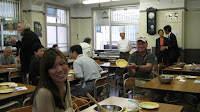
After leaving the Fujiya Seika Factory, the foodies hopped back on the charted bus and headed to Kobe for Kitano Koubou, which is a culinary center and gift shop showcasing Kobe's confectionary offerings. (No, not chocolate cows.) Here, we participated in a baking class, in which we each made an almond fruit tart. Aren't they pretty?


=====================================
Entire Delegation: Tsuji Culinary Institute
=====================================
At the end of our factory tours, the entire delegation met up at Japan's premier Tsuji Culinary Institute. Here, we attended a cooking demonstration held in an auditorium-style classroom, where two senior professors taught us how to make key Japanese dishes. We were also given instructional booklets with illustrations and recipes to take home.

Senior Professor Kazuki Kondo (to the right) was first. He was extremely entertaining and spoke fluent English. He used to be a cook for the Japan's consulate general in San Francisco and called San Francisco his second home. Professor Kondo, with the help of two female assistants (Rose and ??) , demonstrated how to make ichiban-dashi (bonito stock) and kani-shinjyo no suimono (crab ball soup). We were very impressed when he showed us how to turn a petrified, rock-solid piece of bonito fish into delicate snowy flakes that would be used to flavor the dashi. Knowing his life might be in danger if he didn't feed us, assistants carted in sample sizes of the crab ball soup for each of us to try. Yum!

Following Senior Professor Kondo was Professor Yoshitaka Kotani (to the left). Professor Kotani was also very entertaining (in a stiff-sort-of-way) and used a translator to interpret his demonstration. He showed us how to make beautiful hako-zushi, which is an Osakan boxed-style sushi. We each got to taste samples of this as well.

What a neat day this was. The foodies proved that we can be great learners as well as champion eaters :)